Pilates instructor

Why “Exercises To Fix Back Pain” is a Headline to Avoid

Watch the #PilatesHour Episode 105 “Chronic Low Back Pain” with Brent Anderson and Juan Nieto Here.

Juan Nieto PT, DO, NCPT is the director of Polestar Spain and a frequent international lecturer specializing in rehabilitation through movement and athletic performance. In 2016, along with Brent Anderson and Blas Chamorro, Juan founded RUNITY, a start-up created with the purpose of transforming the Running industry by providing runners with the tools and knowledge they need to practice “painless running”.

Brent Anderson PT, PhD, OCS, NCPT, Polestar Founder. With over 30 years of experience in rehabilitation and movement science, Brent is passionate about the power positive movement experiences have in changing the world. Early in his career as a Physical Therapist with a specialty in dance medicine, he discovered the power and efficacy of Joseph Pilates’ mind-body work to expedite rehabilitation outcomes. This early testament to the power of the Pilates Method inspired him to create a program that merged the worlds of traditional rehabilitation with the mindful movement that Pilates provides.


JN: The results of our survey match the prominent studies on chronic pain, and we often see the knee having prominence in chronic pain.

BA: That’s right – our work together with RUNITY has shown us the most common causes of knee pain in runners. These include lack of dorsiflextion, hip external rotation, and thoracic extension.  When we look at society’s sedentary lifestyle, it’s no wonder we see knee pain across the board. 

JN:  If you look at the load management model it makes a lot of sense. There has to be this balance between the load which you apply to the tissues as well as movement distribution and segmental movement. When there is a lack of movement somewhere there has to be excessive movement somewhere else. Especially in places like the low back and knee (hinge stable joints).

Is chronic pain a measure of tissue damage? No, pain does not equate to tissue damage, and typically anything over 3 months is considered chronic by definition.

JN: Most of my patients have had chronic low back pain for 3 or more years and I see a significant amount of clients for this reason. How can we really get a whole perspective of what is going on with clients with CLBP?

We cannot help everyone. It can be hard to accept that there are some patients that we may not be able to help. We may not know enough, and it may not be a perfect fit. Your interventions will work sometimes and other times they won’t. We need to be ok with that.  Every practitioner has limitations. 

The body will heal, especially in the beginning, as in the first episode of back pain.  Each week you may see improvements. By the 20th episode of back pain, things become more complex. This is when the client is usually referred to a physical therapist. 

One of the best things you can do is deal with the acute situation or manage the pain well. The goal is to not allow it to escalate to a chronic situation.

 BA: I really admire the military model of dealing with low back pain. In this, the first two weeks of early intervention are spent differentiating and managing the symptoms. Many of the people following this model get better and do not need MRI’s, medical injections, surgery, or pharmaceuticals. 

JN:  We live in this world in which pain is something we think we need to eliminate. Think about the world “Pain Killers”. As if zero pain is the only valid amount of pain. I think that this is a poor framework. 

If you truly want to kill pain and reduce pain to zero, and this is the goal of your therapy – you are going to fail…

Juan Nieto

However, you must understand that pain is something that your body has in order to tell you that there is a potential threat to your health.

Magic Exercises

Stop chasing the “magic exercises” and “magic recipe” of what to do with your clients who experience low back pain. It does not exist.  People ask me “what is the best exercise for low back pain?”. This is like asking me “what is the best food in the world?”. Who knows! It is entirely individual and a silly question to ask because it depends on the person and the moment.  One exercise can have a beneficial outcome for one person and a negative outcome for another.  

Every time you see a thing on the internet like “exercises to fix back pain” – Run Away! Or at least keep scrolling. 

Juan Nieto

This will result in confusion. Can you imagine people attempting to do this magic exercise with their clients without understanding why they are doing it?  

BA:  So many people write to us asking “what exercises do I do for clients with low back pain?”. Ten people could have the same degenerate disease diagnosis with completely different exercise selections.  Like Juan said, there is no magic recipe.  But we can help you with things like your critical reasoning skills and asking the right questions.  

Critical Reasoning Skills: 

  • Is this a coordination and awareness problem? 
  • Could it be a behavioral problem? They could change the behavior and the problem goes away.
  • Have you considered a load problem? Perhaps they are not conditioned to handle the load in the lower back for longer than 10 minutes.  
  • Is the client presenting a mobility issue? Perhaps the client only moves from one place and has the strategy of moving from this certain place in their spine.  

I have had so many experiences where I have my client do bridging, some pelvic tilts, and breathing exercises. My goal is for them to learn to move from one or two more segments in their back. My patient says “wow I feel 50% better”. 

You have to keep in mind that low back pain can be very different for each individual.  There are times when two of my clients have the same diagnosis. I know there are differences in the individual’s work, relationships, stress, previous injuries, or beliefs, that interfere with their movement. This creates different paths to treatment for two clients with the same diagnosis. 

JN:  We can adopt the mindset of “let’s see what happens” when you prescribe exercises to a client.  There is no such thing as a certain exercise that will fix a problem with a client.  As movement instructors and physical therapists, we must become comfortable with this uncertainty. 

My online course on chronic low back pain, of which I receive terrific feedback from my students does not include any exercises. This was a deliberate decision that I made.  I can’t go and throw exercises into an online format course. Teachers will attempt to use exercises and if they don’t understand back pain and what they are dealing with the results won’t be good.  Treatment of low back pain needs to be based on the movement principles, assessment, interview, ICF model, and understanding of all of the variables and things that influence a client’s pain. 

ICF MODEL

What is the ICF model? International Classification of Function and Disability model developed by the World Health Organization (WHO).

BA: We use the ICF model a lot at Polestar. It is particularly used by physical therapists and medical practitioners around the world.  It is used to classify a person’s physiological, functional, activity, and participation limitations.

At Polestar we put a big emphasis on “participation” in our assessment. We ask the client “what activities do you believe you should be able to participate in?”.  Maybe the response is “cycling 50 miles” or “hiking Mt Kilimanjaro”. Then as a movement instructor, I need to go seek, learn and discover what those activities require in my client’s body. I can then assess my client and look at where they currently are and where they believe they should be.  There is no “miracle sequence” you do twice a day, three times per week. 

Behavioral Bias

JN:  There is another huge group of questions we receive on low back pain. These are regarding the influence of posture, biomechanics, muscle firing, and recruitment patterns on low back pain. You may see some people with “bad” posture with pain and others with the same posture who don’t have any pain.  This is a good reminder that there is really no such thing as good or bad posture for everybody.  There will be certain movements, positions, and patterns that modulate and alleviate pain for some. The same movement can also irritate and create flare-ups for others.  

The wrong exercises for one person could be the right ones for another.  We need to really “move with them” side by side, and together.  Being together, learning together about their experience, and attempting to offer the little amount of movement that their system is able to accommodate.  If you are able to do this, the compounding effect of 1% over and over can lead to very positive results. 

So often people go to the physical therapist to be “fixed” and this is over the expectations of what the reality is. 

They need to get a little new way to deal with their pathology. Just change the trend slightly by 1%, this is the start. Chronic pain is a marathon and this is going to take time.  Some people come into my clinic who have been experiencing pain for 10 years. They have been building this pain for 20 years. They expect to see results in 25 minutes. This is entirely unrealistic. 

What we can do is provide a new way of dealing with it. A more active plan based on what they can do. We can show them the changes they can make in their lifestyle to make little improvements. Maybe we change the pain by 5%, but their perception of quality of life improves by 70%. Just that little bit of relief of disability makes a huge difference in their life. It’s like night and day.  These small changes can give them hope and something to work on which is great.  

BA:  I refer to some of this as behavioral bias. Sometimes we keep looking for a mechanical, physiological, or structural bias. Often times it is a behavioral bias.  They doen’t realize when they are sitting that they are starting to hurt. After 30 minutes of sitting they start to hurt. The goal is to change their behavior to know that the pain is an indicator to get up and move around. They need to catch the warning signs that they need to alleviate that pain that is starting to manifest. It is that first warning sign they often miss.  

JN:  You cannot learn if there is no attention. When you are in pain your attention goes to the painful experience. Your brain gets hijacked and your perception of pain is magnified.  You need the behavioral and cognitive knowledge to examine “what is causing this to happen?”.  Perhaps it’s a long time of sitting.  Your body is telling you that something is not working well for it. You learn to think “what can I do to change this?”.  

Our best Tools – Our Clients

BA:  Our best tools as movement practitioners are in the information the clients give us. Not what we give them.  I ask them “How do you feel when you are in this position? What happens if you move your pelvis this way or another? How do you feel? Does it feel better or worse?”.  

We need to move away from the sedentary world, get on the ground to play. To listen to what the body tells us, and really respect that.  When we’re sitting on the ground we’re changing positions every five seconds. This is because our body tissues are telling us we’ve been in a position too long.  A big step is to heighten our clients’ awareness in of their own bodies. Then they start managing their own symptoms.  Their awareness often turns on at the stage of pain, and by this point, it may be too late. 

If they can learn to identify something that is pre-pain, they start to take responsibility and they have awareness of what is going on in their own body. The more they have these positive experiences, the more their brain will adapt to this to reinforce the new behavior.  We all have our biases.  Our experience influences us, but education can counter a lot of bias.  Clients come in saying “this position is killing me, there is so much pain”. I ask them if they believe there is tissue damage happening right now? Is something tearing, is something breaking?  Usually, their response is “I don’t think so” and I agree with them. If there is no new tissue damage then what do we need to be aware of?  The brain is telling them that they need to be aware of their body and what is happening.  

This “awareness education” is one of our superpowers as Pilates instructors.

Brent Anderson

If we’re telling our clients everything to do and what exercises are going to make them better, then we’re not really helping them as much as we could. I am always amazed at how well people move when they have to govern themselves in their own exercise regime. 

Joseph’s Pilates 

JN: This is of course implicit in Pilates.  In order to do a proper Pilates practice you have to align body, mind, and spirit. This is what Joseph said!  When we are teaching Pilates we have a source and philosophy and we need to be aligned with the method.  

You let the people move like Joseph did, and trust in the process (something I tell my clients often). In the beginning when you start doing exercises you are simply investing. You may not really be able to see any immediate benefit from it for two or three weeks. After that you look back and have gained many benefits.  In the beginning, especially if you are in pain, you are going to be putting forth a lot of effort and time to take care of yourself. During this time noticeable improvement can seem very small.  You have to remember you are investing and in a few weeks, you will see the accumulation of your efforts.

When you allow your clients to move they tend to self-regulate and move well.  When you teach in the style you mentioned, asking your clients questions in order to raise awareness in specific parts of the body…this is huge and an accelerated version of this. 

Are you instructing your clients all the time on how they need to move, what they need to feel, how they need to breathe, and how many repetitions they need to do? I don’t think this has the same effect.  Of course, they may be moving and are probably getting stronger. I don’t think they will be improving their movement skills or communication within their body. 

It’s about letting your clients have the opportunity to be the protagonist of the situation while you guide them. 

Juan Nieto

BA: When you look at motor learning and movement acquisition, there is a balance of external and internal feedback.  In the beginning, it’s going to be a little heavier on the external feedback. This is us as Pilates instructors. As your clients progress into more procedural learning it’s going to be more internal feedback.  What we see sometimes is this “cueing vomit” from new Pilates instructors which can just be too much information for your clients.  We can do so much better! Think of that long-term plan and developing body awareness and mindfulness of their movement. Try to work on taking one step at a time. Just for today let’s start to get an idea of where your head is in space. That internal awareness creates long-lasting change.  When Joseph pilates talked about practicing Contrology every day, he didn’t mean going to a Pilates teacher every day – he meant something else.  


Juan’s Online Course is Live! This self-paced workshop presents the most up-to-date and evidence-based intervention tools for the management of clients with a history of Chronic Low Back Pain (CLBP).

The Best Tools to Maximize Your Pilates Assessment

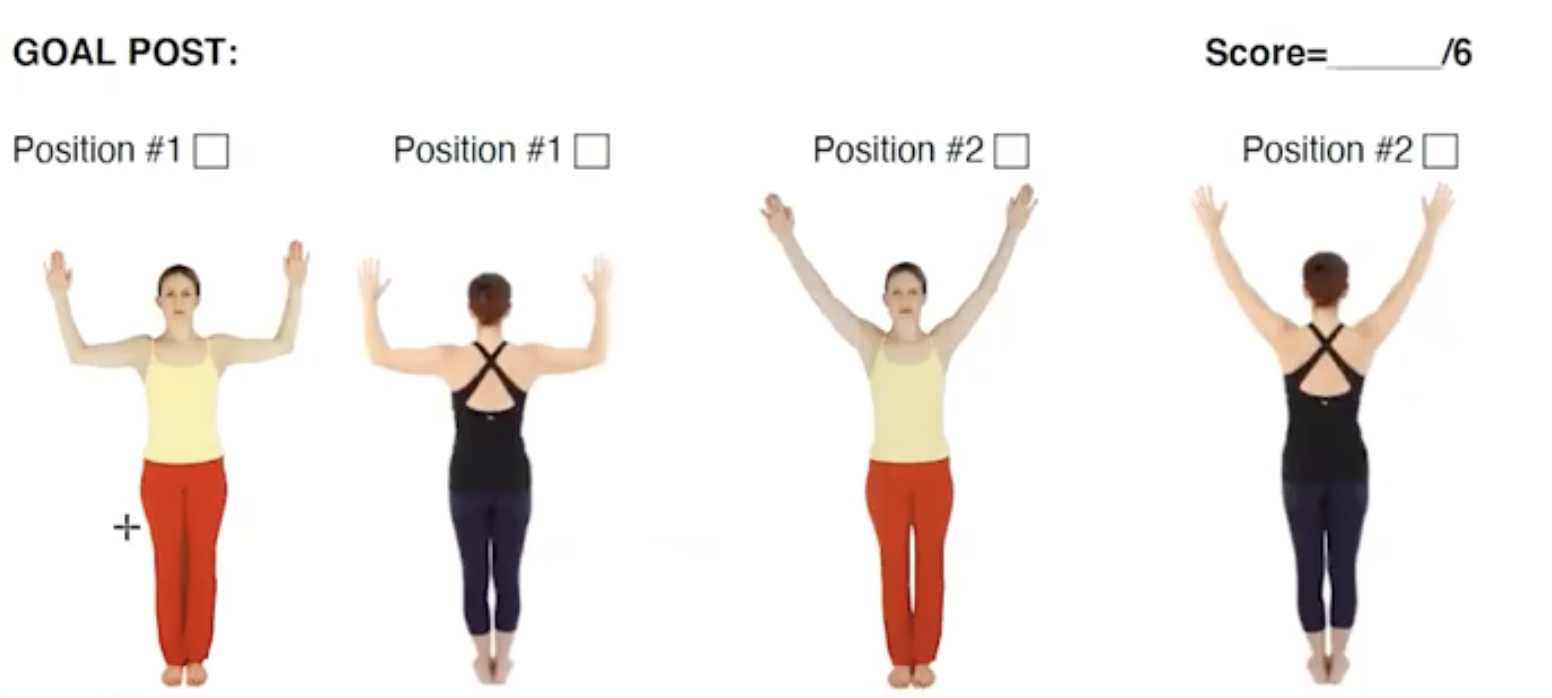
What information can we gather by watching someone perform the goal post?

When assessing the Goal-Post exercise, the client is asked to do three things:

  • Stand up against the wall with their head against the wall
  • Bring the arms to 90/90
  • Bring the arms into a high “V” position

Before cueing the exercise, the first thing to look for is axial alignment.  Can the client position their head over their thorax and thorax over their pelvis while maintaining natural lumbar and cervical curves?

After looking at axial alignment, we look to see what is happening in the shoulder region?

What are some of the things required to be able to bring the arms into a 90/90 position and into a “V” overhead?

  • Shoulder Flexion
  • Shoulder Rotation
  • General Shoulder Mobility

Question: What else connects with shoulder mobility? 

Answer: Thoracic mobility -This is one of the things to look for first when moving into the goal post as it directly impacts shoulder mobility.  If the thoracic spine doesn’t move into extension, the following might be seen:

  • The head comes away from the wall
  • The shoulder girdle can’t slide down into its 90/90 position
  • The back may come away from the wall

Other tests and measures to use to confirm the possibility of a loss of thoracic mobility depend on how other aspects of the movement are functioning.

  • What can be ruled out? 
  • Could it be a loss of scapular mobility? 
  • Could it be a tight pectoral girdle or a loss of humeral rotation in the shoulder such as a rotator cuff injury? 

During the assessment keep in mind, that it could be any of these things and then begin ruling them out.  

Video of Brent teaching assessment using the goal-post exercise.

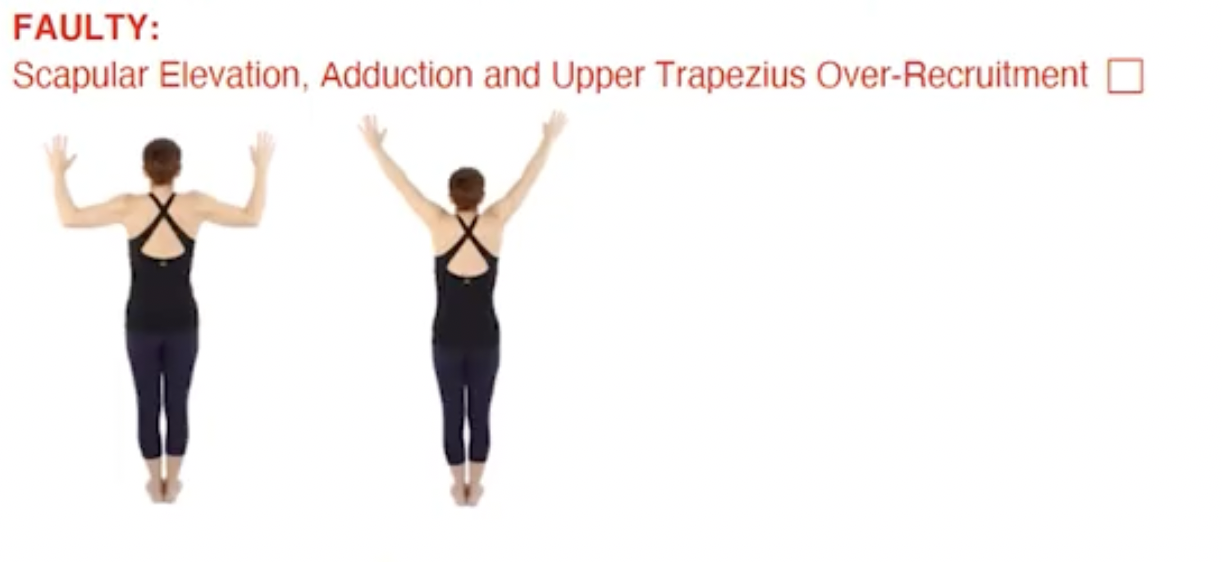
Faulty movement patterns that could be present:

  • The shoulders hiking up to perform the movement (bilaterally)
  • The pronation of the shoulders (very common

Critical Reasoning: Is the client’s limitation in the thoracic spine or in the shoulder girdle?  What other tests might we perform to distinguish between the two?

Asymmetries during Assessment:

When you see an asymmetry, you must seek to understand what the asymmetry is due to. You may see a client who can move one arm back nicely but not the other. If there is scoliosis or a spine deformity, the client might have an asymmetry where one shoulder is being rotated forward. 

  • If there is no scoliosis or spine abnormality, then what is happening at the shoulder blade?
  • Is there a winging of the shoulder blade or poor organization of the shoulder blade?
  • What is happening at the glenohumeral joint?
  • How is it in relationship to the rest of the shoulder girdle?

Assessment Tip: Circle back to the client’s history.

  • Did they have an injury?  
  • Is there any nerve pain? (A brachial plexus lesion could easily cause a limitation in bringing the arm up to 90/90.)

Critical Reasoning: Inquire about the client’s habitual patterns, as some of these daily patterns can create asymmetries, for example:

  • Someone who is always using the computer mouse with tension the right shoulder.
  • Someone who sleeps on one side causeing the shoulder to collapse forward.

The PT and medical world uses what’s called “upper limb tension testing”, one of which tests is to bring the arm up to 90/90 and then straighten it.  A significant amount of people who have had brachial plexus lesions or a thoracic outlet syndrome lose the ability to bring one side up.

Assessment Tip: When an asymmetry is present in an assessment, remember to put a “red flag” on it. Asymmetry means there could have been an injury or something else going on that is challenging the movement. 

Keep in mind – As we Assess we are always:

  • Ruling out
  • Asking questions
  • Seeking to understand:  “What possibly might be causing this?” 

Get the most out of your Assessment and Earn 24 NPCP CEU’s this Summer!

Join us for our upcoming immersion into Critical Reasoning and Assessment Skills:

Critical Reasoning for Rehabilitation and Post Rehabilitation, held this June in Siler City, NC with Polestar Founder Brent Anderson.

How to Motivate your Clients to Keep Moving

Article by By Polestar Educator Carlos Marin Burguillos

Polestar Pilates celebrates 30 Years of Movens Mundi “Moving the World”. Make this year amazing for your clients by motivating them to keep moving!


The definition of adherence to treatment, according to the World Health Organization (WHO), is:

“the extent to which a person’s behavior — taking medication, following a diet, and/or executing lifestyle changes — corresponds with the agreed recommendations from a healthcare provider.”

Adherence to an exercise program or a certain activity, in this case, Pilates, is something fundamental to ensuring the healthy objectives the practice generates are obtained. For this reason, we are going to explore the possible influences, variables, and tools we can implement in our teaching to make this happen.

It should be noted that adherence to physical activity is influenced by the motivation of the subject since it is a psychological component that controls the direction, intensity, and permanence of the behavior (Murcia,2007).

In fact, motivation determines the initiation, maintenance, and completion of behaviors in which we are involved, and its analysis can help us to understand how people begin and continue in physical exercise (Deci and Ryan, 1985). The Theory of Self-determination (Deci and Ryan, 1985), an explanatory model of human motivation, directly relates self-determination to intrinsic motivation. Intrinsic motivation is what drives us to do things for the simple joy of doing them. The execution of the task itself is the reward. To be intrinsically motivated is to take on a problem as a personal challenge. It is to face it just to find its solution, with no hope or longing for an external reward for doing it (Jiménez, 2007). 

This is why being aware of the achievements obtained and the mere enjoyment of the sessions are two essential factors to facilitate motivation and therefore adherence to the pilates program. In this order of things, our work as Pilates professionals gives us a multitude of options to promote the intrinsic motivation of our students and thus improve adherence to the method. 

To facilitate its practical application, I would like to divide these endless elements into two large groups: the development of the program and the pedagogy during the sessions.


DEVELOPMENT OF THE PROGRAM:

In this section, we will cover topics from the selection of objectives to planning the “base exercises” integral to achieving each of these objectives in a session.

In order to maintain and improve the intrinsic motivation of the student, it is important that the exercises chosen are within the student’s comfort zone and close to their limit, allowing for an achievable challenge with determined effort.

As teachers trained in Polestar Pilates we have two tools developed with this purpose in mind:

Polestar Fitness Screening(PFS): A tool through which we can precisely determine the functional objectives for a specific client, to be best able to adapt to their needs.

Polestar Program Design & Sequencing Guide: A tool in which we define the essential exercises of the program according to the objectives determined in the PFS and the ever-changing capacities of the student throughout the program. This we combine with the categories of movement which facilitate developing the program by integrating all planes of movement, positions, and apparatus.

In short, it is about the program being adaptable enough to change instantly to meet the physical and mental state of the student, not the other way around. 

This is most easily achieved in individual classes, where we can modify the pre-established program in a very efficient and immediate way; but how do we achieve this in group classes, regardless of how small they are? 

When working in a group setting, each student presents different characteristics and objectives. Because of this, a personalized adaptation of programming is diminished and we need other tools to give the sessions a certain “mobility”. 

In addition to the basic progressions and regressions of each exercise and the option of creating homogenous single level groups (which is not always possible), I propose three ideas that have been very useful for my study:

  • Before the student joins the group and after the “evaluation of movement ”(PFS), invite them to do at least a couple of private sessions to lay a foundation that at the very least reviews potentially dangerous movements and movements requiring the most modifications for said student. This allows the student to feel more comfortable when joining the group, autonomous, and therefore safe when just by saying “Antonio, the shoulders”, the client knows exactly what you mean, and you can continue the group class with this individual cueing. 
  • Evolve each exercise almost “from zero”, even if it is one repetition for each modification. This will help your students to “enter the movement” and become aware of the state of their body in that precise moment for that specific gesture, to feel the progression in the effort, need for control, coordination, etc., and decide with criteria where to stop or how far to continue with the progression of the exercise.
  • Carry out a collective evaluation once every season (or determined number of weeks) in which each student scores themself, without the intention of “qualifying”, but rather to determine the progress and the points still to be reinforced at the individual level, and mark some general guidelines or “keys” that facilitate the most deficit movements. It will serve as positive reinforcement for the students who already have them integrated and give a boost to those who need it.

PEDAGOGY DURING THE SESSION:

Pedagogy is a general theory of learning that studies the laws of the general process of education and training with an emphasis on creating a learning environment that is suitable to multiple learning styles. I include in this group everything related to the way of teaching during Pilates sessions, which has an influence on the intrinsic motivation of the student.

It is essential to keep the student’s attention focused on the session so that learning can occur. Although many of the factors that influence this process are endogenous to the student, we can significantly influence this process.

LANGUAGE: Let’s divide language into “verbal” and non “verbal” to analyze the way in which it influences attention and student motivation

NON-VERBAL: Non-verbal communication is defined as a process where we transmit information to another person without using any type of word, spoken or written.

Nonverbal communication includes:

  • Gestures
  • Facial expression
  • Eye contact
  • Body language
  • Posture
  • Clothing
  • Spatial distance
  • Physical appearance
  • Rhythm
  • Intonation, and tone of voice

Playing with these variables offers endless possibilities and therefore can significantly influence the perception of the exercise by the student.

For example, the act of walking around the room and placing yourself in different points can influence the students feeling of integration, even more so if you look at each student, nod or smile, or approach and speak privately to a specific student with a lower tone of voice if the moment requires. Take into account the response of each student to these gestures, as not all students feel comfortable when they receive special attention or see their personal space “invaded”. Again the adaptability of your non-verbal language to each concrete learner is the key to success to maintain their focus and motivation.

VERBAL: Verbal communication uses words to convey a message. I propose several ideas that cover various objectives that will influence the intrinsic motivation of your students:

  • Words are associated with connotations beyond their own meaning. For example: “Trying” to do something implies the idea of ​​failure if it is not achieved. This can frustrate more competitive and less skilled students. I propose the word “explore”, where each action becomes part of an exploratory process with no glitches or errors, but movement options.
  • Talk about what you do want your students to do. Sometimes we try so hard to say what “could go wrong” that we are unintentionally pushing our student towards that option, or posing “success” as something so unattainable that it blocks any intention of movement. Look at the difference between these two instructions: “lift your leg and try not to move your pelvis at all ”, vs “raise your leg and feel how your pelvis rests heavily on the mat ”.
  • Use language that is accessible to your students. Using technical language does not elevate your status as a teacher, and what’s more, it could create a gulf between you and the student, making it difficult to communicate. This can generate frustration if the students are unable to understand the exercise when it is supposed to be something within their reach. What’s more, I suggest that you use colloquial words, and from time to time use a joke to break the tension, grab the attention of your students and generate an atmosphere of trust in the session.
  • Teach simply. Sometimes we want to say so many things about the exercise that after two minutes of explanation we still have not transmitted what movement we are asking our students to perform. I propose a simple scheme avoid falling into this error:
  1. Describe the initial position (if it coincides with the end of the previous exercise, eliminate this step).
  1. Define the base movement of the exercise (if it entails any real risk for the student, now is the time to comment. Otherwise, it gives rise to error, because experience is where you learn).
  1. State the objective of the exercise (you do not have to do it explicitly, just state what you want the student to achieve).
  1. Propose some guideline or technical indication that facilitates the achievement of the objective.
  1. Observe the execution and decide if it is necessary to make any correction (touch or verbal), reinforce some part of the exercise, or reward a specific gesture.
  1. If necessary, create a loop between the previous two, or add modifications in the exercise returning to point 2.

TYPE OF INSTRUCTION

In the same way that you can decide what kind of teacher to be (the serious teacher, the authoritarian, the joker), you can choose the way to approach an exercise. Apart from the general teaching guidelines which are more concrete, I propose some fun options:

  • Games: When playing a game, you are able to grasp the attention of your students and help them tap into a more playful feeling. This facilitates interaction between students and creates a bond between them that favors adherence to the method. A simple way to incorporate a game is to have students maintain a certain position that requires balance and have them pass various objects to each other, such as balls with different weights.
  • Simon Says: Once a specific exercise has been explained, modify some aspect with each consecutive repetition. This will keep the student’s attention, in addition to challenging their ability to react to external changes. For example, during one-legged footwork, alternate between one leg and the other, toe or heel of the foot, place of support on the bar, etc.
  • Give it a Turn: Create a sequence of fluid movement in which each gesture links with the following, and when they have it fully integrated, reverse the order of execution, or vary the order of the parts.
  • Improvise: Give specific guidelines that determine the essence of the exercise according to its objective, and suggest that they move the rest of their body freely and even randomly. You can put on music and give them time to express themselves and explore freely.

I hope that this small compilation of ideas has been interesting and especially useful if you decide to put them into practice.Carlos Marin Burguillos Educator for Polestar Pilates Spain, Valladolid.


REFERENCES

Jimenez, M. Intrinsic motivation. Competence, self-determination, and control. On:

Fernández-Abascal, E .; Jimenez, M .; Martín, M. Emotion and motivation: Human adaptation.

Madrid: Ramón Acelles S. A. Study Center, 2007.

Deci, E .; Ryan, R. Self-determination theory: A macrotheory of human motivation,

development, and health. Canadian Psychology, v. 49, n. 3, p. 182-185, 2008.

Murcia, J.A., Gimeno, E.C., & Coll, D.G. (2007). Analyzing motivation in sport a

study through the theory of self-determination. Apuntes de Psicología, 25 (1), 35-51.

Community Highlight: Polestar Practitioner Peter Clerkin

In your own words – describe “the Spirit of Polestar”:

PC: Using Pilates as a tool to create a positive movement experience.

What Three Words come to mind when you think of “Polestar Pilates”?

Holistic

Evolved

Legacy

What do you love about teaching Pilates?

PC: I love teaching because I can express and articulate what is good about Pilates as people do it – I know that a class or an individual person will feel better than they did before at the end of the session and I love to be present to see that change occur. I took my teacher training in London and my educators were Liz Bussey and Diane Nye.

What are your current Inspirations?  

PC: My current inspirations are researchers and physiotherapists trying to understand pain science so that it can be applied to Pilates, or movement practices in general, as a way to build resiliency in our clients. Polestar Educator Juan Nieto does a lot of good work in condensing this research and making it applicable to Pilates

Why Pilates?  How did you find the practice?

PC: I have been a Pilates teacher for almost 10 years – before that, I coached youth sports and earned an undergraduate degree in Sport and Exercise Science. Movement fascinates me and Pilates is a wonderful way of moving and making shapes that is in the moment, fun, and rewarding. Afterward, you feel improved emotional and mental health, and the physical, mental and emotional benefits continue the more you practice.

Pilates takes me into flow more than any other activity.

Why Polestar Pilates?  How did you come to join the Polestar Community?

PC: I felt that it was the gold standard regarding teacher training and I love that across the world we can all find common ground with the training and methods we use.

What do you hope to convey in your teaching?

PC: Moving is vital to being healthy and living a varied and fulfilling life. Also, that it can be fun, explorative, collaborative, and a way to understand your own unique body.

What is your favorite Quote? 

PC:

“The only constant is change”

Simple but powerful, I interpret it as trying to embrace what may come next and adapt to that rather than expecting things to be a certain way.

What is your Favorite Apparatus or favorite way to move?

PC: I love the ladder barrel – I think because a lot of the other apparatus are similar to each other. I like that the ladder barrel is a wonderful way of moving through many directions with your spine and also as a way to perform movements with a greater range of motion around the major joints.


You can find Peter on social media @peterdoespilates and discover teacher training opportunities here.

Unlock the Myth of Intra-Abdominal Pressure


What Is Intra-Abdominal Pressure And Why Does It Matter? 

Intra-abdominal (IAP) pressure is defined as the steady-state pressure concealed within the abdominal cavity and resulting from the interaction between the abdominal wall and viscera; IAP oscillates according to respiratory phase and abdominal wall resistance.

How do we educate people who have lost the capacity to appropriately use intra-abdominal pressure?  Think about the following statement: The appropriate amount of stiffness for the anticipated activity. What does this best describe? Stability? Core Control? Powerhouse? All of these things? 

The answer is all of them. Whether we are talking about stability, the powerhouse, or core control, we should be talking about the same concept. That is, does someone have the right amount of support for the anticipated load or activity? I intentionally use the word anticipated. The brain is using information from past experiences to determine the best approach. This enables us without thinking to know how much stiffness to create in preparation for picking up a jug of milk versus a bag of dried leaves for example.

Joseph Pilates implied that the powerhouse is where things start. What kind of tools do we as movement practitioners have to facilitate the appropriate amount of stiffness for the anticipated load? When asked how they would rank the greatest influencers of intra-abdominal pressure, our #PilatesHour webinar attendees answered as follows:  

A lot of people think it is about muscle control or abdominal strength. This is not the case. When we talk about the abdominal wall and intra-abdominal pressure with our clients, we often confuse them. This is because intra-abdominal pressure involves much more than just the abdominal wall. Intra-abdominal pressure is the stiffness inside the trunk, particularly in between the chest and the pelvic floor. It is this stiffness that is necessary to control the amount of movement based on the load. 

The Power Of Breath 

Breath is a powerful influencer of intra-abdominal pressure. The diaphragm is in fact one of the primary muscles and controllers of intra-abdominal pressure. Some people do not utilize the breath or the diaphragm efficiently or as part of dynamic control. This provides a terrific opportunity for Pilates instructors to affect IAP simply through training efficient and supportive breath patterns. 

The appropriate amount of stiffness is going to be determined by the activity and facilitated by proper alignment. For example, holding your breath in and of itself will create stiffness, but does it create the appropriate amount of stiffness? Is this a stiffness or support that can be maintained for a period of time? Proper alignment and practice lead to efficient and successful movement that seldom has to do with core strength. 

Most of our bodies are given the appropriate amount of strength to be able to handle the movements we choose to participate in. That does not mean that tomorrow, with my body in its current condition, I can go out and perform a 400-pound deadlift if I chose to. I am not conditioned for this activity, nor do I have a need to lift 400 pounds.

However, if I were training to perform that specific loaded movement, my body would naturally start gaining strength by steadily increasing the deadlift weight. Tissue adaptation would happen, meaning that my abdominal wall, my back muscles, and my pelvic floor would all start to change based on the demand that I would be making on those tissues. 

This leads to the question, How much control, mobility, or stiffness is necessary to accomplish the task at hand? 

Let’s say the box in this photo weighs 40 pounds. What parts of his body must recruit and create stiffness to keep him from falling? What if the box were 100 pounds, vs 15 pounds. How would that change the situation? 

When we look at the dynamic movement of kicking a ball, what are they doing and what muscles must be turned on for the person in the photo to be able to kick the ball? Which fascial trains or slings are being activated or tensioned to be able to have the appropriate amount of control of the trunk so that their leg and body can accelerate the foot through space and kick the ball down the field? 

How can we support clients in improving the efficiency of their intra-abdominal pressure? 

  1. Help them find their optimal alignment 
  1. Help them find efficient breath patterns within their optimal alignment 
  1. Progressively load them, working always within ranges where they can maintain the above 
  1. Work through the above points to help them perform the activities in which they want to participate 

With this basic introduction to intra-abdominal pressure, we see that it is more about alignment, breath, and load than focused abdominal work. I encourage you to try facilitating the above points with your clients and see how their quality of movement and integration with activity improve. 


Brent Anderson, PhD, PT, OCS, NCPT is the President and Founder of Polestar Pilates International. Brent is a licensed physical therapist and orthopedic certified specialist with more than 22 years of experience. Based on his extensive background in rehabilitation and movement science, Brent elaborates on Joseph Pilates’ mind-body work through the Polestar curriculum by developing tools for critical reasoning and applying supportive scientific research. He also infuses the integral role of psychology and energy systems on motor control and motor learning.


Brent hosts our weekly webinar #PilatesHour featuring special guests from the movement science field and Polestar community. Watch episode 82 “The Science And Myth of Intra-Abdominal Pressure” here.

Community Highlight: Carlos Marin Burguillos

Carlos Marin Burguillos is an Educator for Polestar Pilates Spain. Discover how to keep your clients motivated to move with Carlos here.


In your own words – describe “the Spirit of Polestar”

CM: It is a way to rediscover natural movement, under the principles of science and self-exploration.

What Three Words come to mind when you think of “Polestar Pilates”

Family

Commitment

Movement

What do you love about teaching Pilates?

CM: I have always loved to train and from a very young age, I frequented gyms. Understanding the why and how of movement multiplied the effects of my fitness training.

Being an educator of future teachers means sharing everything I have learned over the years, in movement and in life. I believe that each person moves and understands movement in a special way, and having the opportunity to share my unique perspective makes me feel whole.

In my Pilates studio, we teach students different ways of moving so that each one can internalize in a way that best suits their way of life. I believe that the freedom to teach and explore within the principles of Polestar is what has helped my students the most to feel good within their bodies.

What are your current Inspirations?  

CM: Currently, I am very dedicated to my movement studies. Leading teacher training courses with Polestar is a window for me to share what I know with others who are moving in the same direction. I would love to be able to convey the little ideas that I develop throughout my experience with as many people as possible.

Why Pilates?  How did you find the practice?

CM: Pilates is the medium and the purpose is to feel good in the body. I learned about Pilates through a friend who suggested I take a class, and since then I have lived from it, for it and with it.

I think that the evolution of science and learning places me more in using the “pilates environment” than sticking to the traditional exercises as shown in the manuals. Knowing why and how to do things is important!

Why Polestar Pilates? 

CM: Polestar was the first school I trained with. I have also completed many courses with other schools. Polestar is a family to me and I have felt continuous accompaniment and support in all areas of my life from Polestar Spain. Polestar International makes it possible for this symbiosis to exist.

What do you hope to convey in your teaching?

CM: I hope to convey the knowledge of the principles to be able to help clients set objectives and carry them out. From there I hope to convey my point of view of the movement – how the support points create the stability necessary to release into the movement.

What is your favorite Quote? 

CM: First move – Then move well – Then move around a lot – And then improvise and be happy.

What is your Favorite Apparatus or favorite way to move?

CM: I think the Reformer is the most versatile apparatus, especially when teaching a group. All of the Pilates apparatus provide options and environments that enable learning.


Carlos is an Educator for Polestar Spain – You can find Carlos on social media @carlosmarin_move