Scoliosis

The Best Tools to Maximize Your Pilates Assessment

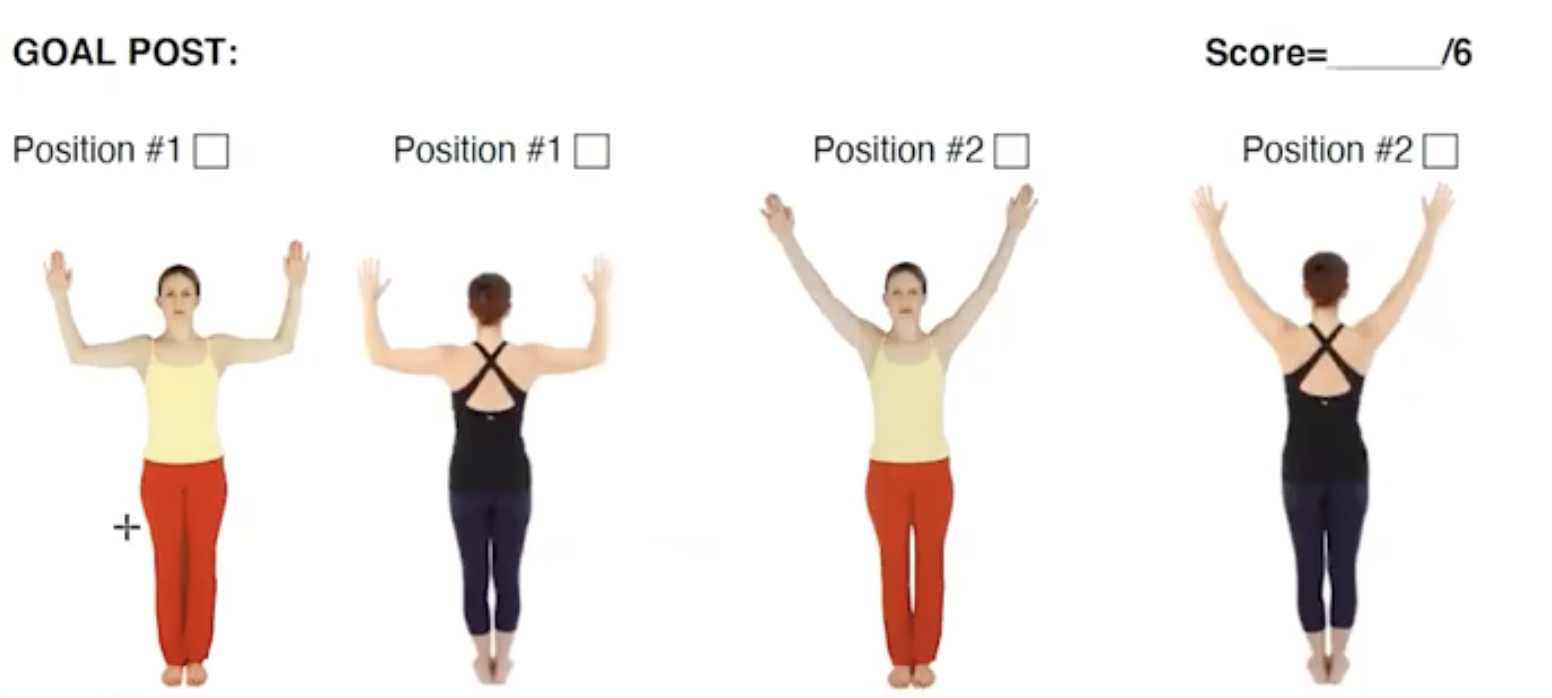
What information can we gather by watching someone perform the goal post?

When assessing the Goal-Post exercise, the client is asked to do three things:

  • Stand up against the wall with their head against the wall
  • Bring the arms to 90/90
  • Bring the arms into a high “V” position

Before cueing the exercise, the first thing to look for is axial alignment.  Can the client position their head over their thorax and thorax over their pelvis while maintaining natural lumbar and cervical curves?

After looking at axial alignment, we look to see what is happening in the shoulder region?

What are some of the things required to be able to bring the arms into a 90/90 position and into a “V” overhead?

  • Shoulder Flexion
  • Shoulder Rotation
  • General Shoulder Mobility

Question: What else connects with shoulder mobility? 

Answer: Thoracic mobility -This is one of the things to look for first when moving into the goal post as it directly impacts shoulder mobility.  If the thoracic spine doesn’t move into extension, the following might be seen:

  • The head comes away from the wall
  • The shoulder girdle can’t slide down into its 90/90 position
  • The back may come away from the wall

Other tests and measures to use to confirm the possibility of a loss of thoracic mobility depend on how other aspects of the movement are functioning.

  • What can be ruled out? 
  • Could it be a loss of scapular mobility? 
  • Could it be a tight pectoral girdle or a loss of humeral rotation in the shoulder such as a rotator cuff injury? 

During the assessment keep in mind, that it could be any of these things and then begin ruling them out.  

Video of Brent teaching assessment using the goal-post exercise.

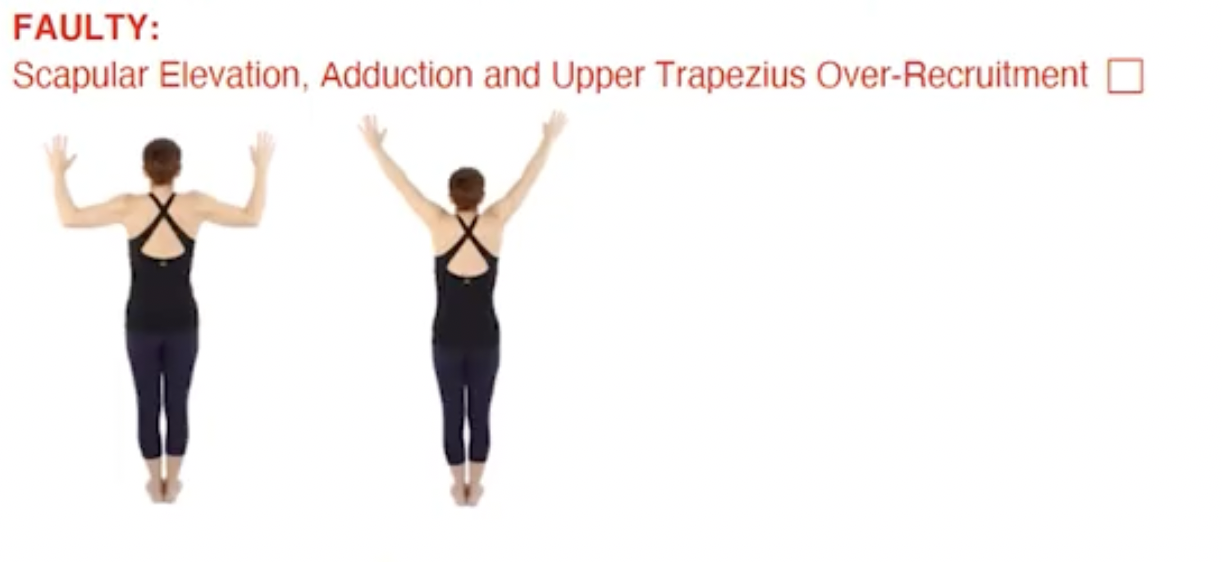
Faulty movement patterns that could be present:

  • The shoulders hiking up to perform the movement (bilaterally)
  • The pronation of the shoulders (very common

Critical Reasoning: Is the client’s limitation in the thoracic spine or in the shoulder girdle?  What other tests might we perform to distinguish between the two?

Asymmetries during Assessment:

When you see an asymmetry, you must seek to understand what the asymmetry is due to. You may see a client who can move one arm back nicely but not the other. If there is scoliosis or a spine deformity, the client might have an asymmetry where one shoulder is being rotated forward. 

  • If there is no scoliosis or spine abnormality, then what is happening at the shoulder blade?
  • Is there a winging of the shoulder blade or poor organization of the shoulder blade?
  • What is happening at the glenohumeral joint?
  • How is it in relationship to the rest of the shoulder girdle?

Assessment Tip: Circle back to the client’s history.

  • Did they have an injury?  
  • Is there any nerve pain? (A brachial plexus lesion could easily cause a limitation in bringing the arm up to 90/90.)

Critical Reasoning: Inquire about the client’s habitual patterns, as some of these daily patterns can create asymmetries, for example:

  • Someone who is always using the computer mouse with tension the right shoulder.
  • Someone who sleeps on one side causeing the shoulder to collapse forward.

The PT and medical world uses what’s called “upper limb tension testing”, one of which tests is to bring the arm up to 90/90 and then straighten it.  A significant amount of people who have had brachial plexus lesions or a thoracic outlet syndrome lose the ability to bring one side up.

Assessment Tip: When an asymmetry is present in an assessment, remember to put a “red flag” on it. Asymmetry means there could have been an injury or something else going on that is challenging the movement. 

Keep in mind – As we Assess we are always:

  • Ruling out
  • Asking questions
  • Seeking to understand:  “What possibly might be causing this?” 

Get the most out of your Assessment and Earn 24 NPCP CEU’s this Summer!

Join us for our upcoming immersion into Critical Reasoning and Assessment Skills:

Critical Reasoning for Rehabilitation and Post Rehabilitation, held this June in Siler City, NC with Polestar Founder Brent Anderson.

Educator Highlight : Lise Stolze – MPT, DSc, NCPT

Lise Stolze is a physical therapist and certified scoliosis therapist through the Barcelona Scoliosis Physical Therapy School / Schroth Barcelona Institute and through the Italian Scientific Institute for the Spine (ISICO).  Her research on low back pain and Pilates has been published in the Journal of Orthopedic and Sports Physical Therapy.  She is a certified Pilates instructor through the Pilates Method Alliance (PMA) and serves on its research committee.  Lise is a principal educator for Polestar Pilates Education and is co-creator of the course Pilates Adaptations for Scoliosis Supporting the Teachings of the Schroth Method.  She owns Stolze Therapies in Denver, Colorado. 

Join Lise in her upcoming continuing education course: Pilates Adaptations for People with Scoliosis Supporting the Teachings of the Schroth Method in Allen, TX: March 27-29, 2020

Polestar: What do you love about teaching?  Where and which whom did you take your training? 

LS: Pilates was a new term to me when I first read an ad for a teacher training at The Pilates Center in 1994. The ad looked intriguing and the weekend module proved to be my first continuing education course as a new PT.  I was thoroughly impressed by the insight into human movement provided by the instructor, Amy Taylor Alpers.  My formal Pilates training began with Barbara Huttner, a protégé of Ron Fletcher in 1995 and continued with Brent Anderson and Elizabeth Larkam in the early days of Polestar Education.  The Polestar training provided the explicit link between movement education and rehabilitation and the language that allowed clear communication with other health care providers about Pilates as a PT intervention.  Dav Cohen and I became Polestar’s first second generation educators in 1999. Pilates has informed my physical therapy practice from those early days in my career and has inspired me to reach out for education and certifications in other forms of intelligent movement such as Gyrotonic® and Yoga.  I still hope there will be a Feldenkrais training in my future!

Polestar: What are your current inspirations?​   

LS: I had a deep curiosity of scoliosis since those early days as a PT and read about the Schroth Method long before I became a certified Schroth specialist.  The investment of time and money seemed too much for such a specialty population and I resisted taking the plunge until 2014.  During my first C1 course with the Barcelona Scoliosis Physical Therapy School (BSPTS), I realized that this was another “intelligent movement” intervention and that it shared many basic principles with Pilates. I have now participated in the C1 and C2 courses several times including recently in Barcelona with Dr. Rigo, the founder of the BSPTS.  The Scientific Exercises Approach to Scoliosis (SEAS) training is the Italian answer to the Schroth Method and specializes in practical and functional approaches to treating scoliosis.  I am currently inspired by the advance of information and research in the area of conservative management of scoliosis.   I encourage anyone who is interested in scoliosis to attend The International Scientific Society on Scoliosis Orthopaedic and Rehabilitation Treatment (SOSORT) conference, which is a platform for the latest research in conservative care of scoliosis.  The conference will be hosted in San Francisco this year – the first time in the US since 2013. 

Polestar: What are you reading or learning about? 

LS: I am currently collaborating on research that will help clarify which adult scoliosis clients require specific exercise modifications based on a broad range of clinical and radiological measures.  These guidelines were developed to inform exercise specialists, physical therapists and the adult population with scoliosis. I will be presenting these guidelines at this year’s SOSORT conference in San Francisco.  Hagit Berdishevsky and I highlight this information in our course: Pilates Adaptations for People with Scoliosis Supporting the Teachings of the Schroth Method. The goal is to publish the guidelines so that the information can reach a broader public audience.

Join Lise in her upcoming continuing education course: Pilates Adaptations for People with Scoliosis Supporting the Teachings of the Schroth Method in Allen, TX March 27-29, 2020

What Are The Best Exercises for Scoliosis?

 Polestar Educator, Physical Therapist, and certified C2 Schroth therapist Lise Stolze offers further insight to Scoliosis and working with Scoliosis clients.  For all upcoming continuing education courses with Polestar visit: Polestar Continuing Education

Most asked questions scoliosis clients ask me about exercise:

  • Should I perform some exercises just on one side?
  • Should I choose exercises that rotate me to the opposite direction of the curve?
  • Should I do an extra set of movements to one side?
  • I just saw research that side plank exercises can reduce curve degrees…should I be doing these?
To answer these questions we must understand how scoliosis affects movement.

What is the Pathomechanism of Idiopathic Scoliosis? (the short version!)

I will be brief since this is a whole course in itself! We know that Idiopathic (no known cause) Scoliosis (IS) is a 3 dimensional spinal disorder that begins with anterior vertebral wedging due to RASO (relative anterior spinal overgrowth) during bone development. We also know that the rotational component of scoliosis exists as both inter-vertebral torsion (rotation of one vertebra relative to another) and intravertebral torsion (an internal rotational distortion within each vertebra), most notably at the apical vertebra (the vertebra most deviated laterally from the vertical axis that passes through the sacrum).1 This distortion contributes to less joint motion at the apex of the curve and more at the transition points of the curve. We see this to a greater degree in adults and to a lesser degree in adolescents who have a more flexible curve before bone maturity. This is apparent in a supine lateral flexion X-ray that assesses curve flexibility.

Three Goals for our Clients with Scoliosis

Movement educators can keep 3 goals in mind when choosing exercises for clients with IS:
  1. Achieve better postural alignment along the central axis
  2. Provide a safe fitness option to increase flexibility, strength and fluid movement
  3. Support sports, recreation and functional activities that enhance quality of life

We Can Improve Posture Through Exercise!

Better posture can be achieved by emphasizing the most fundamental principles of all intelligent movement disciplines:  axial elongation and breathing.  Scoliosis curve concavities are constantly under compression by gravity.  Axial elongation encourages a natural re-alignment of the spine by using neuromuscular activity to reduce multi-plane compression and collapse of the concave side of the scoliosis curves. Once the concavities (which include the ribs) are expanded, then breath can be used to further open the collapse through:
  1. Tactile cueing of the concavities
  2. Unilateral nostril breathing
  3. Guided imagery
The most effective position to learn decompression of the concavities is in a spinal neutral position, out of gravity. Once there is neuromuscular re-patterning, movement can then be transferred to functional positions against gravity like standing, sitting, walking, squatting and lifting where it is more difficult to maintain axial decompression. There are many neutral spine exercises in the Pilates and yoga environment that can be used in this initial phase of re-patterning.

The Side Plank Research Controversy

A research article was published in 2014 claiming that scoliosis curves can be reduced by doing side planks on the convex side of the curve, and was sensationalized in a WSJ article.2  But the research had many flaws3 and while interesting, it cannot make that claim.  Muscular activity on both the concave and convex side of a scoliosis curve is inefficient and exercises that address each side are optimal for IS, including the Side Plank. Consider benefits of the Side Plank based on curve type:
  1. Single Major Thoracic Curve: performing side plank on the convex thoracic side (concavity up) can help strengthen elongated muscles on this side by placing them in a relatively shortened position, and helps to open the concave side, working these muscles eccentrically.
  2. Double Curve, Primary Thoracic: the same can be true for the thoracic curve but now the lumbar curve may be more compressed and specific cueing and/or modification of the exercise must be considered.
  3. Double Curve, Primary Lumbar: performing side plank on the convex lumbar side may be beneficial, but the thoracic curve may be more compressed, and will require special cueing or modification.
  4. Single Curve – Lumbar or Thoraco-lumbar: performing side plank on the lumbar or thoraco-lumbar convex side may strengthen elongated muscles on this side by placing them in a relatively shortened position and helps to open the concave side, working these muscles eccentrically.
  5. Adult with Degenerative Scoliosis (Lumbar): receive the same benefits as Single Lumbar curve but if there is a lateral instability (listhesis), then this exercise may not be indicated.
In all curve types, performing the Side Plank on the concave side of the primary curve is much more challenging but also beneficial.  This brings us to the importance of performing a scoliosis assessment to determine the curve type.  In the case of adult degenerative scoliosis, an X-ray must be obtained and collaboration established with a health care practitioner who has a deep working knowledge of scoliosis evaluation and management.

Safe Exercises for Spine Mobility

Life takes us out of neutral spine…shouldn’t we train our scoliosis clients how to move their spine effectively out of neutral?  The answer is of course yes…. but which movements and how much?   This depends on your assessment of the client:  Are they in pain?  How much movement does the apex of each curve have?  What is the curve type?  What other muscle imbalances or injuries exist? What are their goals?  Considering that the scoliosis spine tends to move more at the transition points and less at the apices, we may want to limit end range movements and emphasize elongation in postural shapes that minimize compression of the curve concavities.  This will be more difficult for those with a double curve. So it is important to make critical decisions with your client based on your evaluation and their goals.

Recreation and Sports: Can it Be Done with Scoliosis?

Everyone with scoliosis should be free to enjoy activities that increase quality of life! What does you client love to do?  Sports activities such as dance and gymnastics involve many compressive spine positions for scoliosis….as do golf and tennis.  Each person must be evaluated for the risk that their chosen activity may have on their scoliosis.  Considerations for age, curve type, activity frequency, and muscle imbalances must be made. Clients should be educated about scoliosis spine mechanics and progressions to help them make an informed decision about the activity they choose.  A fitness or movement session with your client could focus on training to maintain axial elongation and openness of the concavities during sport. Just as likely and equally important, a session could simply focus your client back to their center line!

Education and the Need for Individualized Programs

Polestar founder Brent Anderson, PT, PhD, OCS reminds us of the importance of working within our own scope of practice. It is crucial to invest in your education to increase your effectiveness and level of safety with your scoliosis clients. Find a professional you can partner with, join a network of practitioners with like interests, and take courses to keep yourself current with scoliosis research. If you are the client, make sure that your Pilates teacher or therapist has the training to create safe and effective exercise programs for you and your needs.

For all Upcoming Continuing Education Courses: Continuing Education with Polestar


References: 1Dickson RA, Lawton JO, et al. The pathogenesis of idiopathic scoliosis. Biplanar spinal asymmetry. J Bone Joint Surg Br. 1984;66(1):8–15. 2 Fishman LM, Groessl EJ et al.  Serial case reporting yoga for idiopathic and degenerative scoliosis.  Global Advances in Health and Medicine.  2014;3(5):16-21.   3 Salvatore M, Zaina F, et al.  Letter to the editor: Serial case reporting yoga for idiopathic and degenerative scoliosis. Global Adv Health Med.2015;4(1):79-80.

————–

Lise Stolze, MPT, DSc PMA®-CPT, is a certified C2 Schroth therapist, Polestar Educator, and owner of Stolze Therapies in Denver, CO. She has co-created Pilates Adaptations for people with Scoliosis with Schroth Scoliosis Therapist and BSPTS educator Hagit Berdishevsky, PT, MSPT, DPT, Cert. MDT. Lise has been published with her research on Pilates and Low Back Pain. 

Working with Clients with Scoliosis

A teaser by Polestar Pilates International on the topic of our course: Scoliosis and Spinal Conditions, Pilates Master Course with Scroth educator Hagit Berdishevsky and Polestar educator Lise Stolze (Stolze Therapies)

WORKING WITH CLIENTS WITH SCOLIOSIS

Scoliosis is one of the most stubborn, abundant disorders in growing children and teens. The good news is that Pilates professionals can help ease the pain scoliosis sufferers experience through movement. The question is, how does one go about helping someone find peace with this condition?

WHAT IS SCOLIOSIS?

Scoliosis is a skeletal deformation, usually the result of growth spurts during adolescence, congenital spinal abnormalities, and other defects. 65 – 80% of scoliosis cases are idiopathic or of unknown origin. In sufferers, the spine is bent out of shape (no pun intended). Sometimes minimally or sometimes dramatically, the spine contorts into a C or an S shape. The Cobb angle is widely used to test for scoliosis, which is a measure done by locating distorted vertebrae and marking their paths on the back.

Early onset or early childhood scoliosis appears before 5 years of age and makes up 2% of all reported cases. It is sometimes associated with severe respiratory failure and, by affecting lung growth, may lead to decreased respiratory capacity even before puberty. Late-onset idiopathic scoliosis appears after 5 years through adolescence and usually occurs at puberty, around age 10. In such cases, complications with breath and healthy lung function have been reported. When left untreated, these conditions are exaggerated and the spine can be very distorted, to the point where the backbones can only be fixed through surgery. Most cases of scoliosis, however, resolve themselves with age, moderate exercise, and physical therapy.

HOW TO TREAT SCOLIOSIS

Lise Stolze and Hagit Berdishevsky discuss working with scoliosis clients on Pilates Hour.

ALTERNATIVES FOR SCOLIOSIS TREATMENT

  • Observation: where the deviation does not exceed 20º.
  • Use of corset: Used to slow the progression of the curve during the growth stage in people whose curvature is between 20º and 45º.
  • Surgery: Stop the evolution of the curve and, if possible, to correct it. It is indicated for the minors of growing age whose curve is greater than 45º and for adults with curves higher than 50º.
  • Physiotherapy and active rehabilitation: These treatments seek to slow the progression of curvature, improve respiratory function and reduce pain.

These types of treatments can be combined with different techniques. These include electro-stimulation through medium-frequency currents, heat treatments with IR to increase tissue elasticity and circulation, and lumbar traction to reduce compression in the spine. Kinesiotherapy uses movement-based exercises that include stretching, exercises to strengthen weakened muscles, and those that seek to invert the curves of the spine by position.

Therapeutic exercises for scoliosis treatment are based on principles that we manage day by day in Pilates such as postural reeducation, flexibility and muscular strength. The Schroth Method is a good example of a regimen that targets scoliosis to reduce pain and the rapid growth of scoliosis. The method focuses on postural and breathing exercises, spine flexibility, and convex-side stretching. It has been praised for being effective in minimizing symptoms.

These tips will not cure scoliosis, as most forms will resolve themselves naturally. However, these techniques will greatly reduce the discomfort that usually comes with this disorder. This is also true for recovery from extreme scoliosis. The key is to continue positive movement experiences and expanding our knowledge of this disorder to gain insight on how best to stop it.

What are the best Exercises for people with Scoliosis? Click here.


To learn more about the online course, click here: Scoliosis and Spinal Conditions, Pilates Master Course

Like our Blog? Subscribe to Polestar Life Weekly and be the first in the know!

Helping Children with Scoliosis in Africa

Many therapists and instructors are compelled to apply their knowledge of movement in different ways to benefit society. Hagit Berdishevsky is one such person, whose passion for health has lead her to cooperate with FOCOS (Foundation of Orthopedics and Complex Spine) foundation in Africa. World-renown orthopedic surgeon Dr. Baochie-Adjei founded FOCOS with one goal in mind – provide life-changing, spinal surgeries to children in his home country of Ghana, and in other developing nations in Africa. Hagit applies her extensive knowledge in working with scoliosis to aide in the recovery of these children.

This slideshow requires JavaScript.

Dr. Boachie-Adjei is known globally for his extensive knowledge of spine deformity and special expertise in the treatment of scoliosis, kyphosis, and spine reconstruction in adult and pediatric patients.  Originally a group a 250 volunteers, FOCOS set to work on administering hundreds of free spinal surgeries to patients in the region. In 2008, Dr. Boachie-Adjei and his team moved from their humble clinic, Watson House, to the FOCOS Orthapedic Hospital. It was constructed with over $20 million in donations, boasts state-of-the-art medical equipment, and treats patients from all over the globe. They are committed to sustainability, education and research on spinal injuries in these developing nations. Some of the rarest, riskiest surgeries are performed by FOCOS – surgeries many other surgeons wouldn’t dare touch. Almost 50,000 patients have been treated worldwide, with conditions ranging from complex spinal deformities to knee prostheses. If you are curious about the different surgical interventions, videos of Dr. Boachie-Adjei performing these surgeries are on YouTube.
Video courtesy of FOCOS Hospital
Hagit’s background as a physical therapist makes her perfect for her role in the patients’ recovery. Over fourteen years ago, she graduated a Physical Education and Sports Science program with a focus on Postural Defects Cultivation in Israel. In 2010, she earned her certification as a Schroth Method Therapist by the Asklepios Katherina–Schroth Clinic in Germany and uses this method with the recovering children. Hagit is one of 5 Schroth Method professionals in the United States. She is incredibly passionate about her work. Hagit and Polestar Educator Lise Stolze have combined their knowledge of how best to treat patients with Scoliosis in the course: Pilates Adaptations for People with Scoliosis. This is a course for conservative care of idiopathic Scoliosis (IS). In this course they incorporate breath techniques and modify Pilates mat exercises for Scoliosis. You can learn Pilates adaptations for Scoliosis patients, based on the Schroth Method, from Hagit and Lise. Join them in our upcoming courses in Allen, TX.  You can make an impact on world health by learning new skills like these. In fact, any way you choose to make an impact makes a difference.